Braces
/ Orthodontics
What
is Individual Orthodontics
Individual
Patient (IP) Orthodontics is an improved version of
the standard (straight archwire) orthodontic treatment.
Instead
of using a “one size fits all” bracket
and archwire system like conventional braces do, IP
Orthodontics uses customized braces and wires, unique
to your anatomy and case goals. IP Orthodontics’
customization leads to faster, more effective treatment
and better retention.
An
IP dentist uses the most advanced orthodontic tools
to provide you the highest levels of orthodontic treatment.
|
 |
Why
Get Braces?
Most
people have considered getting braces and improving their
smiles some time in their lives. Braces can improve your
appearance and improve your dento-facial health.
Orthodontics
includes the repositioning of your teeth with continual,
light forces. Dentists attach specialized brackets onto
your teeth, and slide a wire that fits your mouth’s
shape to help move your teeth gently into place. Your dentist
may also use other helpful tools like rubber bands, retainers,
and headgear to also improve your smile.
Why get braces?
Most people who have jaw and tooth problems can be helped
significantly with braces.
- Obtain
a Healthy, Beautiful Smile — Straightening
your teeth and improving your bite will help you better
prevent tooth decay, gum disease, and facial joint and
muscular problems. When teeth and jaws are in the proper
position, it is easier to clean, bite, chew, speak, swallow
and smile properly. A healthy smile is also a beautiful
smile and can give you a new-found confidence and affinity
toward smiling.
Badly spaced and crooked teeth can lead to periodontal
disease (signs include red or swollen gums). Periodontal
disease can eventually cause tooth decay, tooth loss,
and even affect your heart’s health long term. Straightening
your teeth and aligning your bite can help you prevent
these serious and sometimes costly problems.
- Straighten
Misaligned Teeth
— Do you dislike how your teeth look when you smile?
Braces can correct your crowded, turned, over-spaced or
misaligned teeth. This can improve the aesthetics and
health of your smile. Braces can help align your teeth
to allow for improved hygiene and facial aesthetics and
can reduce periodontal problems.
- Correct
Jaw Problems
— Do one of your jaws protrude or not close properly?
Do you feel clicking or pain in your jaws? Orthodontics
by itself or with other tools can help you fix a jaw misalignment
(malocclusion) when your upper and lower jaws do not align
properly. Aligning your jaws can fix many problems, including
asymmetry, abnormal wear on teeth, jaw protrusion, chewing
issues, and speech impediments. A proper bite can also
relieve jaw joint pain, and headaches.
Why
Individual Orthodontics?
Your dentist
uses the most advanced orthodontic tools, to provide you
with the highest levels of orthodontic treatment. Instead
of a “one size fits all” approach used in typical
straight wire appliances, your dentist customizes your braces
and wires. Since the braces have been specifically made
for you, faster and more effective treatment can be expected.
- Customized
— IP Orthodontics gives dentists 10 times
more bracket and archwire designs to choose from, creating
a treatment-specific set of braces. Each tooth is diagnosed
to find the best bracket for the intended direction of
tooth movement. Your braces will be designed and made
for you.
- Faster
Treatment — Treatment with the IP Appliance®
has been shown to be at least 6 months faster than the
current straight archwire appliance treatment. Since treatment
time varies significantly by severity, age and anatomy,
speak with your dentist to get a better projection on
your treatment time.
- Fewer
Treatment Visits — Due to the use of long-acting
materials and the reduced need to make archwire corrections,
intervals between visits can be extended. This means less
travel and time in the dentists’ chair, with better
results.
- More
Comfort — Since your braces and wires are
customized to you, you have less wire changes, pain and
irritation.
- Better
Smiles — IP Orthodontics’ diagnosis
compensates for unwanted tooth movements. Computer aided
diagnosis accurately predicts your teeth’s path
to its final position, shortening your treatment time
and reducing unexpected tooth movements.
- Improved
Retention
— Retention has improved significantly by straightening
the teeth more effectively, earlier in treatment. Customized
brackets specific to each tooth’s rotation are applied
to fully straighten your teeth. Since your dentist does
not need to make as many archwire compensations throughout
the treatment, your teeth are straightened to their final
positions earlier and have improved capacity to retain
in that position.
The
Science Behind It
The IP Appliance®
has proven to be the most effective method of practicing
orthodontics. Cases finish in 40% less time by adding torque
and rotations early in cases. This system also uses the
optimal archwire shape for each patient based on each individual’s
anatomy and case goals. More importantly, results are more
stable as teeth have been in their final position for longer.
Your dentist
uses brackets and archforms customized to you, to minimize
wire bending. IP Orthodontics incorporates the clinical
knowledge of force application and skeletal resistance to
appliance design so the dentist can more efficiently make
the corrections, with better treatment results.
Through the specifications
of your doctor’s precise diagnosis, the IP Appliance®
anticipates and compensates for unwanted tooth movements
and other clinical effects before you even have braces on.
This efficiency minimizes the need for the dentist to make
compensations in the archwire. Using a custom welded or
bonded bracket can be used to increase certain torque, rotation,
and tipback to offset known problems before they happen
on a case-by-case basis.
This customization
improves the consistency of your results and will give you
the best looking smile. Your braces will be individually
designed, tailored to your anatomy and case goals with these
components:
- Brackets specific
to each tooth
- Custom welded
bands
- Archwires
specific to your facial characteristics and tooth movements,
guiding your teeth within the size and shape of your unique
bone structure
- Long acting
nickel-titanium springs and wires to extend the time between
treatment visits
- Computer
aided diagnosis of the best bracket and wire combinations
for each treatment
Computer-Customization
An IP smile uses
computer generated orthodontic technology that produces
faster and more stable results. Your braces will be individually
designed for the most effective and fastest treatment. With
the aid of a computer, your dentist diagnoses your teeth,
bone structure, and facial profile to develop your treatment
plan and customize your brackets.
Your dentist
uses cutting edge orthodontic technology to create the optimal
treatment plan for you. Your doctor analyzes every detail
before the case starts to interpret any potential problems
before they happen. Some of the technologies used include
digital cephalometric analysis, model measuring, visual
treatment objectives and over 150 treatment plan templates.
After your dentist
completes a comprehensive diagnosis, he/she places an order
to Progressive Dental Supply to customize your specific
braces. Welders will execute the precise angles, torques
and rotations to your unique bands, brackets and wires.
After going through quality control, your Individual Patient
Appliances® are sent back to your doctor to start your
orthodontic treatment.
Is
It Right for Me
Types
of Cases
Individual Patient
Orthodontics by itself or in conjunction with other dental
tools, can help correct almost every type of tooth and jaw
misalignment. Tens of thousands of successful cases from
all over the world have already proven that this is the
most efficient way to straighten your teeth. See some common
cases below that an IP dentist can help you with.
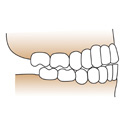 |
Crowded
Teeth — When the total width of your
teeth is greater than that of the surrounding bone
and soft tissues, teeth can become crowded, misaligned,
and crooked. This often can cause hygienic and gum
problems.
Braces
will align teeth into a larger arc called an archform.
The front teeth generally move forward as the teeth
are straightened, proportionate to the amount of crowding.
Your dentist makes your computer prediction and attaches
your customized nickel-titanium archwire with “memory”
to your specially designed IP Appliance® bracket.
Since the customized IP bracket is bonded to the rotated
tooth, it will gently reposition your teeth into alignment. |
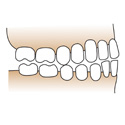 |
Widely
Spaced Teeth — This occurs when the total
width of your teeth is less than that of your dental
bone and soft tissues. This can happen if you have lost
teeth, or your jaw has grown too much. Braces can help
close the gaps between teeth. Treatment can help you
prevent certain types of periodontal (gum) diseases
and tooth decay. |
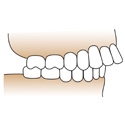 |
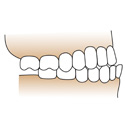
Overbite
— This happens when your upper jaw protrudes too
far in front of your lower jaw. This can happen if there
is over growth in the upper jaw, or a lack of growth
or missing teeth in the lower jaw. Dentists often refer
to overbite as “overjet”. Overbites can
cause uneven wear on teeth and painful functional jaw
problems. |
 |
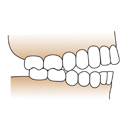
Underbite
— This happens when your lower jaw protrudes in
front of your upper jaw. This often happens when the
lower jaw over grows or there is a lack of growth or
missing teeth in the upper jaw, and can be genetic.
Dentists often refer to underbite as “reverse
overjet”. Underbites can affect eating, speech,
and jaw joint pain. |
 |
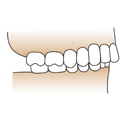
Open
Bite — This problem happens when your
front upper and lower teeth do not touch when you bite
normally. This can often cause lip incompetency (lips
failing to touch when at rest), gummy smiles, airway
problems, muscle strain, and abnormal swallowing. In
conjunction with braces, you may be able to work with
your dentist to control habits that contribute to your
open bite. |
 |
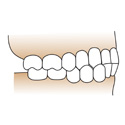
Closed
Bite — When you bite normally, your upper
teeth hide your lower teeth excessively. With normal
bites, the bottom 2/3 of your lower front teeth is visible.
Fixing closed bites can improve unwanted wear on your
front teeth, correct abnormal breathing or eating habits,
and align your muscles and jaws. |
 |
Cross
Bite — This happens when some upper teeth
close inside (closer to the tongue than) the lower teeth.
Cross bites can happen with the front and/or side teeth
misaligned. This can happen if your jaws are mismatched
in size or from genetics, and can cause skeletal asymmetry,
bad wear on your teeth, and jaw joint pain (TMD/TMJ). |
When
Is The Best Time
As soon as problems
can be identified, a plan should be formulated for the eventual
correction of each problem. Each problem has a “best”
time to make the correction. A crowded tooth may be straightened
at any time, but if a tooth is straightened and held in
the corrected position for a longer time, then retention
of this new position is improved. Some bite problems are
best treated during periods of growth, while others require
a significant amount of patient cooperation and may be better
treated as an adult or child.
Many problems
can be identified as early as age 6-8. The American Dental
Association (ADA) recommends children to have an orthodontic
evaluation by their dentist by 7 years old, in case there
are any corrections that can be better corrected early.
Missing permanent teeth, bite discrepancies, impacted teeth,
and skeletal problems can all be identified on x-rays and
visual examination by trained dentists.
Children
Orthodontics
for Children
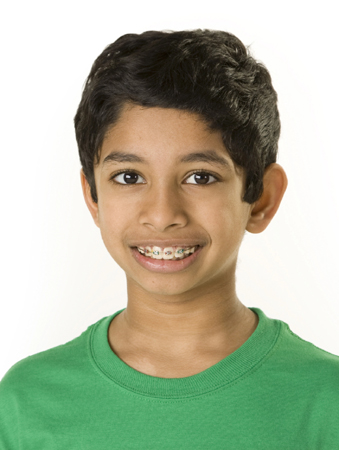
Starting
early can improve your child’s chances of obtaining
a perfect bite.
Early
treatment (treatment started before all permanent
teeth erupt), can often be more effective than later
treatment. This can sometimes be the best way to completely
correct a dento-facial problem.
It can
sometimes be harder to obtain a full correction if
treatment starts after the full eruption of permanent
teeth. Early treatment (Phase I treatment) can take
advantage of a child’s growing bones and muscles
to correct and stabilize bites optimally. Phase I
treatment can include gently widening a small jaw
to fit in crowded teeth, using a habit corrector to
avoid abnormal development, and other appliances that
can guide jaws and muscles to create a perfect bite.
Starting treatment early can often minimize and often
fully correct jaw misalignment problems, and reduce
time in full braces, when added in Phase II (after
full permanent teeth erupt).
The final
straightening, bite correction, and establishment
of the best smile with use of full braces is reserved
for Phase II. This usually takes place at approximately
age 11 in girls, age 13 in boys, but of course this
timing is very individual.
The American
Dental Association (ADA) recommends children to have
an orthodontic evaluation by 7 years old. The dentist
can take records to see if there are potential problems
for your child’s future that are unseen without
machines and records. If needed, your dentist, will
list the treatment goals of Phases I and II at the
consultations, using computerized prediction methods
to make the most accurate diagnosis.
|
 |
How
long is the treatment?
Phase I treatment
(that time before full eruption of the permanent teeth)
can be 1-5 years, depending upon when the problems have
been identified and the treatment plan established. Phase
II treatment (the time where full brackets are usually worn)
often is 12-18 months if a Phase I has been completed prior.
In every case,
a re-evaluation with new records will be made before the
start of the second phase to confirm the diagnosis.
More
cost?
Phase I+II treatment
is usually more expensive than Phase II treatment only,
given the longer treatment time, more treatment visits,
and increased doctor time spent on the case. Most doctors
who choose to start treatment early do not fully charge
for their time, being more interested in the quality of
the final result. It is typical that 2-phase treatment is
10-20% more costly than 1-phase (wait until all the permanent
teeth erupt) treatment. The longer time allowed for payment,
however, often makes the more expensive 2-phase treatment
more affordable to the parents than 1-phase.
A value judgment
must be made for each individual and for each problem, since
every case is different. Your dentist will make recommendations
specific to your child, and treating as if they were his/her
own.
It is advisable
that a comprehensive long-term treatment plan be formulated
and coordinated year-by-year to reach the final desired
result. Some years no treatment is done, other years may
be reserved for full braces. By doing this, the chance of
a full correction is more predictable, with the smile that
everyone wishes realized in a high percentage of cases.
Is
2-phase treatment an efficient approach?
It is most important
that the materials and appliances used in early treatment
are long-acting, increasing the time between visits, and
therefore reducing the total number of treatment visits.
With a dentist using the IP Appliance®, you often have
50% less treatment visits. Computerized appliance diagnosis
and the application of brackets and archwires specific for
the patient characteristics and treatment are essential
to reducing doctor time in these longer cases, in the process
saving you money.
By diagnosing
tooth-by-tooth, as is done in IP Orthodontics, the final
tooth position may be established early in treatment, reducing
the time and energy to make the final tooth movements in
the second phase. Efficiency is on the mind of your dentist
in a 2-phase treatment, so please follow directions.
Teens
Orthodontics
for Teens
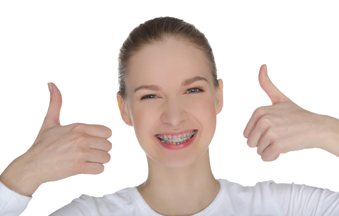
Get your winning smile with braces that are unique
to YOU
Now
in the 21st century, wearing braces is common amongst
teens, and is even considered trendy in many schools.
While many decades ago, wearing braces was considered
ugly and awkward, now it’s considered a common,
fashionable way to get a winning appearance.
Often the
best time to get braces is as a teen. As a young adult,
you are making the decision to create a smile that
will last you a lifetime.
You are
not alone. Your teenage years are the most common
time to get braces. You can be proud of your beautiful
new smile at school since braces can give you a new-found
confidence and smile.
|
 |
How
long is the treatment?
The full IP Appliance®
system on your treatment will help you obtain the most efficient
clinical efficiency and 40% less treatment time than traditional
braces. While IP Braces look just like conventional braces,
the appliances’ customized torques and rotations will
allow you to get your braces off quicker than your friends.
It baffles me
how fashionable braces are sometimes. Recently I told a
patient that it was time to get their braces off, and he
told me, keep it on longer!
Adults
Orthodontics
for Adults
You can be proud of the new smile you’ve always
dreamed of!
Today,
25% of all orthodontic cases in America are adult
patients (defined by the “non growing”
definition). More adults are getting braces than ever
before. Many adults inquire about orthodontic treatment
to improve their appearances, dental hygiene, health
of their gums, and reduce headaches and jaw joint
pain.
The IP
Appliance® has been successful for patients up
into 82 years old. IP Orthodontics continues to help
adults from all types of backgrounds, ages, and desires:
- You
had braces when you were younger and want to correct
your teeth that shifted from not wearing retainers.
- Orthodontics
was not affordable in your family when you were
younger.
- You
have misaligned jaws which is causing pain or clicking
in your jaw joints, headaches, or problems chewing,
swallowing, or talking. You hope to correct your
bite and fix functional problems before they get
worse.
- You
refused to wear braces in your formidable teenage
years, but are now ready to take your smile to the
next level.
- You
have always wanted to transform your smile, and
are ready to invest yourself for a healthier, more
confident smile.
Although
dentists cannot use growth to their advantage to treat
certain skeletal malocclusions, the lack of growth
is not really a limitation to treatment results for
more common dental corrections. With a fresh, full
smile, you too can see dramatic results.
|
 |
How
long is the treatment?
Because adults
have fully mature jaws, treatment time may take slightly
longer than that in adolescents. Individual variance in
tooth movement is common. Your doctor will likely know after
2-3 months how fast your individual teeth will move. The
full IP Appliance® system on your treatment will help
you obtain the most clinically efficient and rapid treatment
time.
Although metal
braces are the most efficient, your dentist can often offer
cosmetic brackets, for a higher fee and longer treatment
time. Braces can fit your lifestyle, whichever you decide.
|




 Imedia West